

Warehouse Panel
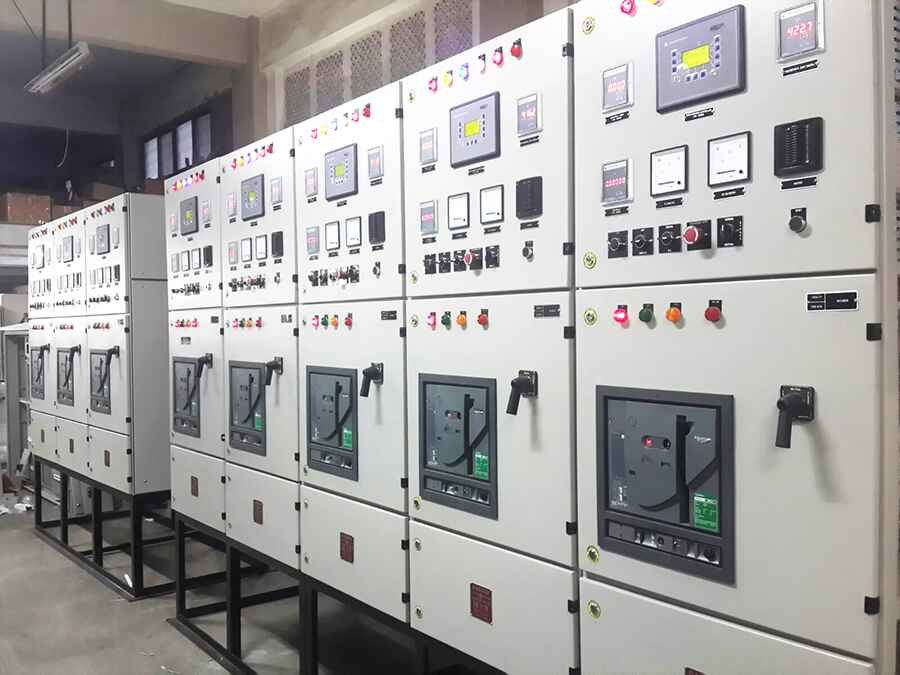
What is a Warehouse Panel?
A Warehouse Panel is a vital component of electrical systems used in industrial settings like warehouses and large storage facilities. These panels are designed to efficiently distribute and manage electrical power across different areas of a warehouse.
They ensure that power is supplied safely and reliably to machinery, lighting, and other equipment. Built with high-quality materials and advanced technology, these panels offer durability and long-term performance, making them an essential part of any warehouse’s electrical infrastructure.
Key Features:
- Robust Construction: Designed to withstand the demanding environments of warehouses, these panels are built with durable materials to ensure long-lasting performance.
- Efficient Power Distribution: Ensures optimal distribution of electrical power, reducing energy wastage and ensuring smooth operation of warehouse equipment.
- Customizable Design: Warehouse panels can be tailored to meet specific power requirements and can be adapted to various industrial settings.
- Safety Compliance: Manufactured in accordance with international safety standards, providing secure and reliable electrical management.
- Easy Installation and Maintenance: Designed for straightforward installation and hassle-free maintenance, minimizing downtime and operational disruptions.
Applications:
- Warehouse panels are ideal for a wide range of industrial applications, including:
- Lighting and HVAC Systems: Efficiently managing electrical power for lighting and heating, ventilation, and air conditioning systems within large warehouses.
- Material Handling Equipment: Ensuring a stable power supply to equipment such as conveyors, cranes, and automated storage systems.
- Security and Surveillance Systems: Powering security cameras, alarms, and other surveillance equipment to maintain safety and security within the warehouse.
- Inventory Management Systems: Supporting the smooth operation of systems that track inventory, including automated stock tracking and warehouse management systems.
At DJ Electro Controls, we are a trusted warehouse panels supplier and warehouse panels manufacturer, committed to delivering top-quality products that meet the diverse needs of industrial and warehouse facilities.
A Warehouse Panel is not just an electrical device it is the operational backbone of modern logistics, storage, and manufacturing environments. For facilities in India where heat, dust, voltage fluctuations, and scalability challenges are daily realities, these panels provide reliable control, precise distribution, and long-term value.
At Dj Electro Controls, we engineer Warehouse Panels with a focus on efficiency, maintainability, and suitability for Indian industrial infrastructure.
The Strategic Role of Warehouse Panels in Industrial Power Distribution
Warehouse Panels are engineered to handle power distribution across multiple zones of activity—loading bays, automation conveyors, HVAC, lighting, and sensitive surveillance systems. Unlike basic distribution boards, these panels are tailored for environments where uptime, safety, and electrical integrity are non-negotiable.
In large-scale operations, a single fault can ripple across the entire workflow. A well-designed Warehouse Panel isolates the issue without disrupting overall operations. Power is intelligently routed to avoid overloads and downtime, allowing critical systems to remain online while faulty circuits are disengaged.
Engineering for Indian Warehouse Conditions
Warehouses in India face highly variable conditions—high summer temperatures, heavy dust accumulation, and unreliable grid power. These realities guide every aspect of panel design.
Heat Resistance
Panels are thermally rated to function even in environments with 50°C ambient temperatures. We use heat-resistant insulating materials and ensure proper ventilation via filtered air channels.
Dust Control
Fine industrial dust is managed through IP54/IP65 enclosures, sealed cable entries, and anti-dust filters.
Power Instability Protection
Voltage dips, surges, and harmonics are mitigated using surge protection devices, voltage stabilizers, and circuit isolation techniques.
Unlike off-the-shelf solutions, these panels are stress-tested to perform under real Indian conditions for years without degradation.
Technical Anatomy: Inside a Warehouse Panel
Each panel is a modular assembly comprising several subsystems, designed for clarity, accessibility, and thermal performance.
Main Incomer Section
Handles the incoming power from the utility or transformer, equipped with MCCBs or isolators.

Busbar Chamber
Insulated, color-coded copper or aluminum busbars efficiently distribute power and support thermal expansion.

Outgoing Feeders
Consist of MCBs, MCCBs, or RCBOs based on load types, connected to control terminals.

Monitoring Instruments
Voltmeters, ammeters, energy meters, and indicator lamps help operators detect irregularities in real time.

Control Logic
Incorporates contactors, timers, or PLCs when automation or conditional logic is required.

This internal structure is designed for modularity—so upgrades, replacements, and maintenance are fast and non-intrusive.
Integration with Automation and Digital Systems
Modern warehouses increasingly rely on connected systems. Warehouse Panels can interface with industrial automation protocols through:
- SCADA/PLC Integration : Panels communicate with central automation systems to control processes based on logic or time cycles.
- Remote Monitoring : With digital meters and telemetry relays, users can track load conditions remotely and receive alerts.
- Energy Optimization : Smart relays and analyzers identify inefficiencies and peak load trends to optimize consumption.
- Data Communication : Modbus, RS485, or Ethernet support enables seamless integration with warehouse management systems.
These features support smarter decision-making and maintenance scheduling.
Risk Mitigation and Downtime Prevention Features
Electrical faults in warehouses can halt critical operations. Our panels are built with preventive layers of protection:
- Phase Monitoring Relays : Detect phase loss, imbalance, or reversal to protect motors and drives.
- Overload and Short Circuit Protection : High-quality breakers and thermal relays isolate faults instantly.
- Surge Suppression : Arrestors and filters protect against voltage spikes from lightning or grid switching.
- Redundancy Options : Panels can be configured with dual incomers, auto-transfer switches, or load-sharing setups for critical circuits.
These features reduce downtime and protect expensive machinery from electrical damage
Lifecycle Value: Efficiency, Maintenance, and ROI
While the upfront cost of a Warehouse Panel includes engineering, materials, and testing, the long-term return on investment is significant
Lower Energy Losses
Optimized copper sizing and efficient routing reduce internal line losses
Reduced Maintenance Interruptions
Modular construction allows selective part replacement without powering down entire systems.
Extended Operational Life
With regular servicing, panels last 15–20 years without major upgrades.
Predictable Costing
Spare parts availability and design standardization simplify budgeting for replacements and servicing.
These panels are not disposable components they are engineered assets.
Load Study and Scalability Planning
Incorrect sizing leads to either insufficient capacity or overspending. We approach each Warehouse Panel with a data-backed load study.
With this approach, you get a system that is both efficient today and ready for tomorrow.
Compliance, Testing, and Certification in India
All panels comply with relevant Indian and international standards:
Panels can also be third-party inspected upon request for quality assurance or compliance purposes.
IS 8623 & IEC 61439 for low-voltage panel construction
BIS-approved breakers, busbars, and components
Factory Acceptance Testing (FAT) for insulation, earthing, dielectric strength, and operational functionality
Panel Test Records: Every panel comes with test documentation, drawings, component lists, and certificates
Common Engineering Errors in Warehouse Panel Design
Several procurement errors can lead to long-term issues. Here’s how we engineer around them:
- Inadequate Breaker Ratings : We calculate exact ratings based on starting currents and device types.
- Poor Enclosure Selection: Using IP40 instead of IP54 leads to dust ingress in Indian conditions.
- Lack of Expansion Provisions : Panels must be designed with at least 20% expansion margin.
- Incorrect Neutral/Earth Separation : Can lead to safety violations or circuit malfunction.
We identify these risks early during design and build accordingly.
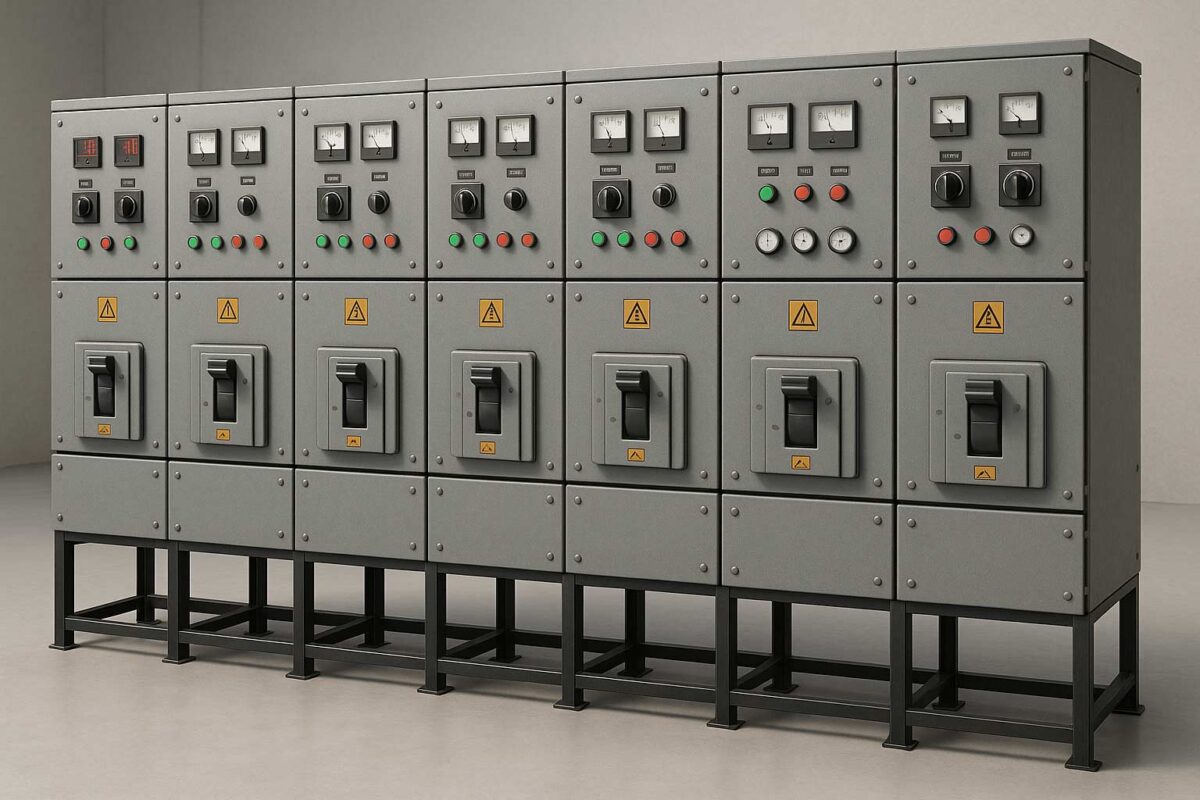
Warehouse Panel Procurement: Buyer’s Technical Checklist
Before procurement, facility managers and engineers should verify the following parameters to ensure full compatibility with site conditions and operational needs:
Required incoming and outgoing breaker ratings
Testing requirements such as FAT, on-site commissioning, and third-party inspection
Panel operating environment (indoor, semi-outdoor, rooftop, etc.)
Load types: resistive (lighting), inductive (motors), electronic (VFDs)
Provisions for digital monitoring or control integration
Desired enclosure IP level for dust and moisture protection
Short circuit fault level (kA) ratings
At Dj Electro Control, every Warehouse Panel is configured only after these parameters are reviewed in detail helping clients avoid overspending or underestimating their actual power management needs. This checklist forms the foundation for a well-engineered, site-specific solution.
FAQs
Q1: What is the difference between a Warehouse Panel and a standard MCC panel?
An MCC (Motor Control Center) is designed specifically for controlling motors. A Warehouse Panel handles broader power distribution—including lighting, automation, HVAC, and more. It includes MCCB/MCB, metering, protection, and expansion-ready features.
Q2: How do I determine the panel size for my warehouse?
We recommend a full load study that accounts for your present load, peak demand, and future expansion. For instance, a warehouse with 60HP motors, 30kW HVAC, and 10kW lighting may need a 250A–315A panel with harmonic compensation.
Q3: How often should a panel be inspected or serviced?
Basic inspections should be done quarterly. Breaker testing, earth resistance measurement, and thermographic scanning should occur annually. Filters and dust-proofing elements may need monthly checks in high-dust zones.
Q4: Can I use these panels in an older warehouse with outdated wiring?
Yes, provided the incoming wiring and load termination are assessed. We also recommend verifying earthing and insulation resistance before panel commissioning.
Q5: What is the typical lead time for commissioning?
After delivery, standard commissioning takes 1–2 days depending on complexity. It includes testing of all breakers, phase rotation check, earth continuity verification, and load run.